


Fawn roundleaf bat
A species of Old world roundleaf bats, Also known as Gould's leaf-nosed bat, Fawn horseshoe-bat Scientific name : Hipposideros cervinus Genus : Old world roundleaf bats
Fawn roundleaf bat, A species of Old world roundleaf bats
Also known as:
Gould's leaf-nosed bat, Fawn horseshoe-bat
Scientific name: Hipposideros cervinus
Genus: Old world roundleaf bats
Content
Description General Info
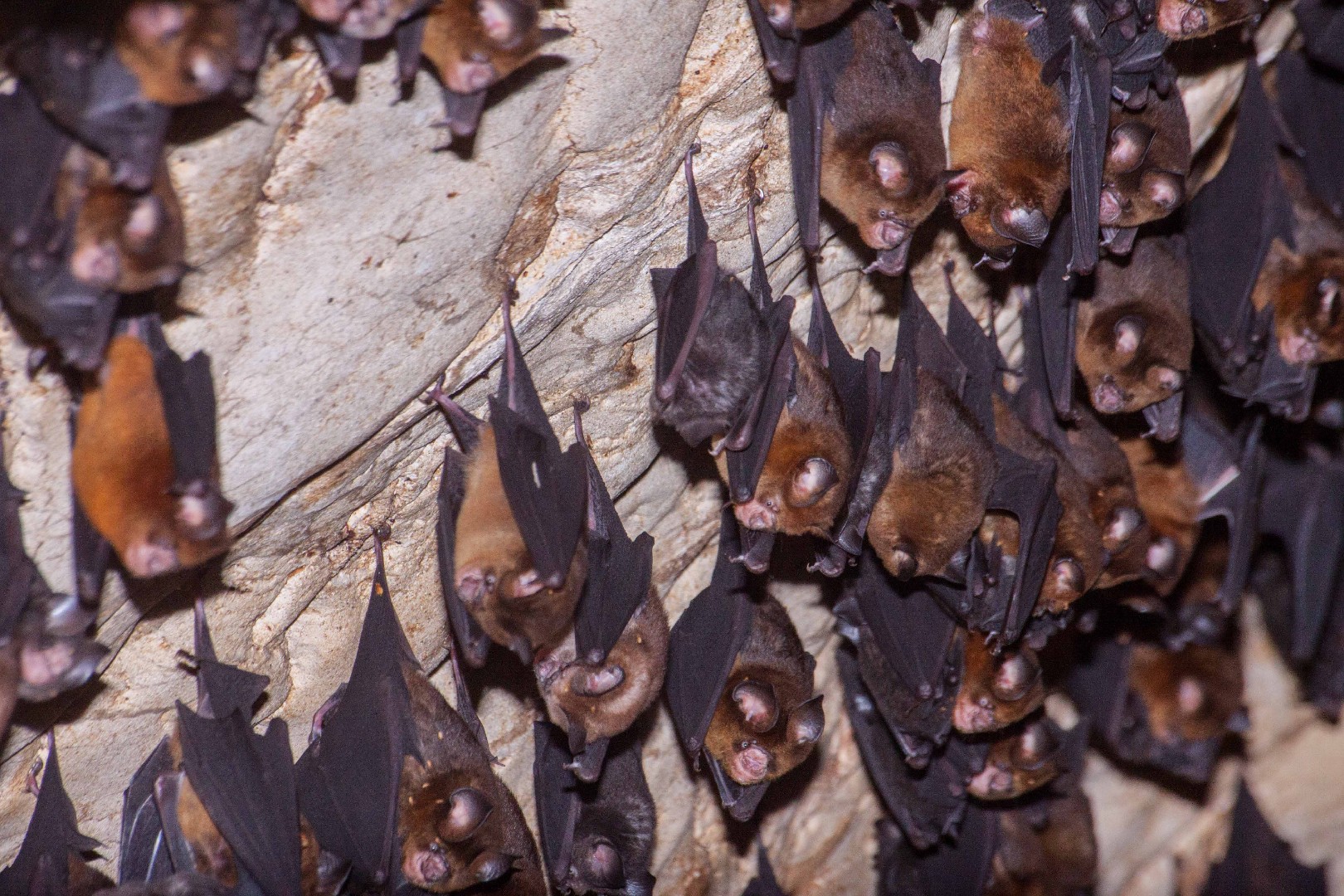 Photo By Daverbennett , used under CC-BY-SA-4.0 /Cropped and compressed from original
Description

Hipposideros cervinus is a medium-sized hipposiderid with two lateral leaflets on its nose leaf. Noseleaf is greyish pink, ears triangular. Pups are dark gray in coloration, maturing to a dark brown in adults which often becomes bleached over time, turning a bright orange colour due to the ammonia from droppings in communal roosts. The nose-leaf distinguishes the species by its squarish outline which is broader at the lower part, below the nostrils, where small leaflets extend from either side of this structure. The funnel shaped ear becomes pointed at the tip. The colour of the pelage is variable, appearing as a uniform grey to russet highlights over a more greyish brown shade and sometimes presenting as a bright orange colour. The range of measurements describing Hipposideros cervinus for the forearm are 45–48 millimetres, the combined head and body length 41–51 mm, ear length from the tip to the notch at base 13–15 mm. The average mass, derived from a range of 5.6 to 8.5 grams, is 7.0 grams. 

General Info
Lifespan
9-11 years
Diet
Fawn roundleaf bat is an insectivorous mammal, feasting predominantly on small, soft-bodied insects. It utilizes echolocation for precise hunting, often consuming beetles, moths, and spiders, constituting a crucial part of its dietary regimen.
Appearance
Fawn roundleaf bat is a medium-sized bat typically weighing around 14-28 grams. It has a slender, elongated body and large, broad ears. Its fur is velvety, dark brown on the dorsal side and lighter below. Notable is the presence of a leaf-like, pointed projection in the center of its nose. There are no significant differences in appearance due to age, gender, or subspecies.
Behavior
A communal rooster, is commonly found roosting in caves and trees. In 1958 Medway estimated the Niah population to be 250,000. Hipposideros cervinus is recorded roosting at caves and abandoned mines in groups of individuals that suspend themselves separately, rather than huddling together, and are found cohabiting with other species of hipposiderid bats. They forage in a variety of habitat, from dense rainforest to open woodland in savannah landscapes. Their prey are mid-sized insects caught in flight close to low vegetation, over water and near to the ground. They fly at slow speed and with a high degree of manoeuvrability while foraging for invertebrates such as beetles and moths, allowing them to hunt at low altitudes and make sudden changes in direction to catch its prey. H. cervinus are recorded as hunting in small groups, Reproduction is a single birth during November to December. Juveniles attach themselves to their mother by clasping her ventral side with their head facing away, maintaining this position whether she is at the roost or in flight, but turn in the other direction to receive food from their mother. 
Population
Decreasing


Scientific Classification
Phylum
Chordates Class
Mammals Order
Bats Family
Old world leaf-nosed bats Genus
Old world roundleaf bats Species
Fawn roundleaf bat 
AI animal expert in your pocket



Scan QR code to download


